10 February 2010 — One of our friends in Germany sent to us this ad which apparently played during the Superbowl last Sunday. I am not a football fan… I am not a TV fan either. I watch it very rarely. Sometimes for the news and that is about it. So I had not seen this ad on TV. Maybe some of you had already seen it, but it is worth seeing again. It is really funny and yet I don’t think it mocks the green movement. On the contrary, this ad embraces it but in an extreme kind of way. A little bit like self-deprecating humour.
Canada to Introduce Plastic Money (Plastic Bills)
10 March 2010 — In its latest budget just introduced a few days ago, the Canadian Government announced it will introduce plastic dollar bills starting next year. These dollar bills will be replacing the current cotton-based money.
According to the Canadian Government, this is a “green” step because the new plastic bills are reportedly ore durable as they last 4 times longer than the current biodegradable money. This will represent savings for the Canadian Governments as this new money is cheaper and harder to counterfeit.
The Best Non-Plastic Mattresses
31 March 2010 — While the mattresses that my grand-mother used to sleep on were made out of cotton, wool or straw (she was born in 1907), nowadays they are mostly made of foam. Petroleum-based polyurethane foam used in mattresses breaks down over time and, according to a study by the Consumer Product Safety Commission reported in the Washington Post in April 2008, releases 0.802 mg of antimony and 0.081 mg of boric acid (the poison used to kill cockroaches) in the air every night. These amounts are apparently OK if you are more than 5 years old (!). And formaldehyde – declared toxic under the Canadian Environmental Protection Act – can be present in box spring glue. Conventional mattresses for children may also contain phthalates, and often flame retardants such as poloybrominated diphenyl ethers (PBDEs are banned in Europe and are being phased out in the United States… but are still very legal in Canada).
My friend Jean Corriveau is a pioneer in the world of non-plastic healthy mattresses and he manages his business in a very honest and ethical way. He is just the nicest person, full of integrity, who would never compromise on quality. He is the owner of Sleeptek which developed a completely natural mattress line 15 years ago in response to demands from some of his highly chemical-sensitive clients. His Obasan mattresses are not only made of organically grown cotton and sustainably harvested natural rubber, but the wool he uses comes from a family-run organic sheep farm in the Netherlands. The wood in the box springs comes from Quebec spruce — sustainably harvested — and no synthetic glues, dyes or finishes are used. (Read more:http://www.nationalpost.com/life/footprint/story.html?id=2072160#ixzz0jif8xE9h)
THE GREEN KEYS TOUR – Visionary Eco-Pianist FRANK HORVAT Live
10 April 2010 — Life Without Plastic is thrilled to be a sponsor for virtuoso eco-musician Frank Horvat‘s Green Keys Tourof solo piano performances across Canada. And what makes an ‘eco-musician’, you ask? According to Frank it means the musician is carrying on their professional activities in a sustainable way and minimizing their carbon footprint. Take a look at all the ways Frank is doing this on The Green(ing) Musician page of his website. The tour will raise funds for the Earth and promote Frank’s latest CD – A Little Dark Music – of original piano compositions, which explore “real world themes like the environment, poverty and Sept 11. Despite the somewhat sombre and serious subject matter, A Little Dark Music attempts to bring peace, joy and contentment to its listeners.
Canned Food You Can Trust – A list of BPA-Free Lining Canned Products
We continually hear about how bad bisphenol A (BPA) is for everybody and particularly for infants and pregnant women. The evidence is there. For those still skeptical, the precautionary principle dictates that you should be cautious. It is mind boggling that the food industry is so slow to remove BPA from the lining of food cans. Fortunately, some food companies understand the problem and have switched to non-BPA linings for their cans. They do not necessarily advertise this fact on their cans, so you need to memorize this list! Here they are:
1) Eden Food: They have been using BPA-free linings in their cans for more than 10 years! How visionary! Although the cans cost 14% more, the company feels it is worth it. I think so too. While Jay and I generally avoid buying canned food because of BPA, we are happy to indulge in a good vegetarian chili with non-BPA canned beans once in a while. Unfortunately, Eden’s tomatoes are still offered in BPA-lined cans because of the acidic nature of tomatoes… So try and find a brand of tomatoes packaged in a glass jar. This is especially important because acidic food increases the deterioration of the BPA lining and thus increases its leaching.
Become an Environmental Leader: Switch Wine Bottles from Glass to Plastic?
13 May 2010 — The website EnvironmentalLeader.com recently praised Marks & Spencer for switching all of its mini wine bottles from glass to “environmentally-friendly” polyethylene terephthalate (PET) plastic in the UK market. Since when has PET plastic become more environmentally-friendly than glass? From an energy consumption point of view, plastic production uses marginally less energy than glass (2,013 BTUs for PET versus 2,155 BTUs for glass) and perhaps this is where plastic may appear more environmentally-friendly. But if you look at the total life cycle of one single bottle, plastic and glass, you realize that glass is significantly superior:
- Glass containers can be cleaned and reused several times as part of consignment programs. We use milk from the company Harmony Organic (TM) which comes in a glass bottles that the company collects back, cleans and refills. PET bottles should not be reused as they deteriorate very quickly and can present increased health risks.
- Glass is highly recyclable, in fact it can be recycled eternally, because its structure does not deteriorate when reprocessed. Plastic bottles can only be recycled once. They can then simply be downcycled into an item that would not be used for food or drink such as fabric fibres for bags or clothes.
TOXIC AMERICA on CNN with Dr. Sanjay Gupta: The chemicals that surround us…
2 June 2010 — CNN is about to premiere a feature special called Toxic America focusing on the toxic chemicals that surround us in everyday life, whether we realize it or not. The show will be hosted by Dr. Sanjay Guptaover two nights (June 2 and 3, at 8pm EST and PST) and will in large part focus on the health and environmental effects of toxins found in plastics. Here’s a little video promo of the series.
As explained on the website of the Center for Health, Environment and Justice, Night #1 (Wednesday) will be an “hour-long investigative story into the environmental health and justice problems plaguing the community of Mossville, Louisiana. Nestled amidst an alarming cluster of chemical plants, Mossville is home to more PVC chemical plants than anywhere else in the entire country, and has been dubbed the Vinyl Manufacturing Capital of America.”
Night #2 (Thursday) will deal with the effects of “hidden toxins” in all of us, particularly expectant mothers and their babies. It will also feature a profile on Jeanne Heagle, who has been living plastic-free for over 2 and 1/2 years. This investigative series links well with the stunning book we have talked about often in the past: Slow Death by Rubber Duck.
Our Everyday Plastic Consumption is Like an Ongoing Giant BP Oil Leak
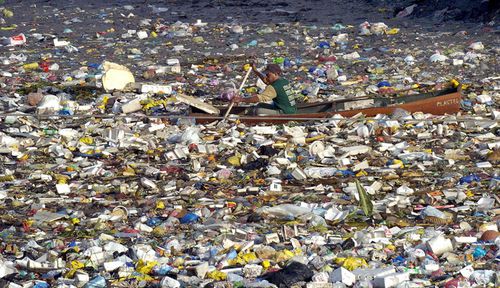
Think about it… all of the oil that is spewing out of BP’s open underwater well can be compared to all the plastic we throw out in the environment every single day… Go to a take out restaurant and take a look at the garbage cans. The amount of disposable plastic in there multiplied by millions corresponds to the amount of plastic that is discarded every day in the world. It is estimated that there are at least 200 billion pounds of plastic in the ocean. We look in horror at the gushing oil well, but we contribute to just as much pollution collectively every day by consuming and throwing out so much throw-away plastic.
An article by Daniella Russo, executive director of the Plastic Pollution Coalition entitled “The other, bigger ‘oil spill’: Your use of disposable plastic” made me reflect on the fact that we contribute every single day to the pollution of our environment through petroleum-derived objects we throw out.
21 June 2010 — Think about it… all of the oil that is spewing out of BP’s open underwater well can be compared to all the plastic we throw out in the environment every single day… Go to a take out restaurant and take a look at the garbage cans. The amount of disposable plastic in there multiplied by millions corresponds to the amount of plastic that is discarded every day in the world. It is estimated that there are at least 200 billion pounds of plastic in the ocean. We look in horror at the gushing oil well, but we contribute to just as much pollution collectively every day by consuming and throwing out so much throw-away plastic.
(Photo: seacat.wordpress.com)
An article by Daniella Russo, executive director of the Plastic Pollution Coalition entitled “The other, bigger ‘oil spill’: Your use of disposable plastic” made me reflect on the fact that we contribute every single day to the pollution of our environment through petroleum-derived objects we throw out.
“We are simply using too much disposable plastic for the small percentage that gets recycled to even make a dent. And, unlike paper, glass, or stainless steel, most plastic can only be “down-cycled,” or used for increasingly fewer purposes. All the recycling, like using a teaspoon to empty the ocean, simply can’t stem the tide of plastic engulfing us.” (…)
“The most powerful thing people can do to clean up the oceans is to refuse to use “disposable” plastics in the first place. Let’s add “Refuse” to the list of R’s: Refuse-Reduce-Reuse-Recycle. Until we reduce our use of plastics wherever possible, real change will not happen. Recycling or cleanup projects alone won’t cut it.”
It takes a lot of will power to plug that gushing well of disposable plastic production. Just as every small plastic-use gesture contributes to creating it, every small gesture can also help plug it.
Chantal Plamondon, Co-Owner
LifeWithoutPlastic.com

The Plastic Industry is Rejoicing Over Its Conquest of our Daily Lives
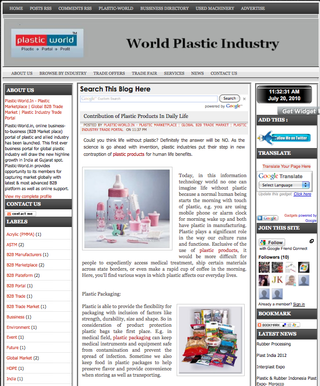
Check out this post on a website called “World Plastic Industry”. It describes how plastic has become indispensable in our daily lives… starting with your mobile phone and alarm clock, it goes through everything we use on a daily basis including packaging and building materials. It makes me feel so sad to realize that we have been won over with subtle but durable changes to our lifestyles that now seem irreversible. Irreversible because in some cases, we have completely lost the incentives to create non-plastic alternatives because the whole infrastructure has changed to accommodate plastic-based solutions. One good example comes from the packaging industry. Plastic is now being recognized as the only “hygienic” way of packaging take-out food. When I approached a local restaurant in my town to offer some reusable stainless steel containers for take out food, they decided to pass because they could not be certain people will clean their containers properly, and they do not want to take responsibility for bacteria that could eventually contaminate the food.
Video: Plastic Mistaken for Zooplanktons
This is a very short video showing how easily plastic bits can be mistaken for zooplankton by marine mammals and fish. It is quite astounding. This video was put together by 5gyres.org and the water sample was taken from the North Atlantic plastic gyre… Did you know five of those plastic gyres have now been discovered. Yikes!