Sorry, More BPA Bad News – This Time Soft Drink Bottles

6 March 2009 — I had hoped my second official post to this blog would be happier than my first, but alas, there’s breaking bisphenol A news that needs to be shared.

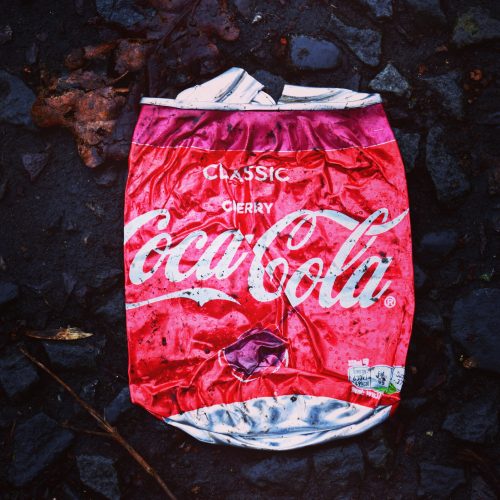
A Health Canada study entitled Survey of Bisphenol A in Canned Drink Products was recently posted on the Health Canada website and published in the Journal of Agricultural and Food Chemistry.  Government scientists tested 72 kinds of canned pop – covering 84% of the market share of soft drink products sold in Canada – and found that 69 of them contained BPA at levels below the accepted daily intake pre-established by Health Canada. But peer-reviewed research increasingly indicates that exposure to extremely low amounts of BPA may lead to significant adverse health effects.  For example, look into the ground-breaking research of Frederick vom Saal, a global expert on endocrine disruptors, including BPA.
Stainless Steel in Toaster Oven Prevents Aluminum Garnish on Burrito

2 December 2009 — Yesterday, I was looking for something to eat and found in our freezer a frozen Amy’s Burrito (unfortunately wrapped in plastic). I checked the instructions: either re-heat in a microwave or wrap in aluminum foil and re-heat in oven. Heating it up in a microwave oven was not an option. We haven’t had a microwave oven for more than 10 years.  Ever since my mother passed away of stomach cancer in 1992, I always wondered if the old microwave oven we used to have in the middle of our kitchen caused her cancer. I am convinced it was “leaking” radiation. It was one of the first models available on the market in the ’70s. I have also always wondered how the radiation affects the composition of the food, let alone of the container used to heat it up.

Heating it up in aluminum can be perilous. In contact with acidic food, aluminum tends to “melt” or disintegrate which is why you often see little holes on the aluminum foil covering a lasagna. Scary! So this was not an option either.

Replacing Your Polycarbonate 5 Gal Bottle with A Snazzy Italian Stainless Steel Water Dispenser

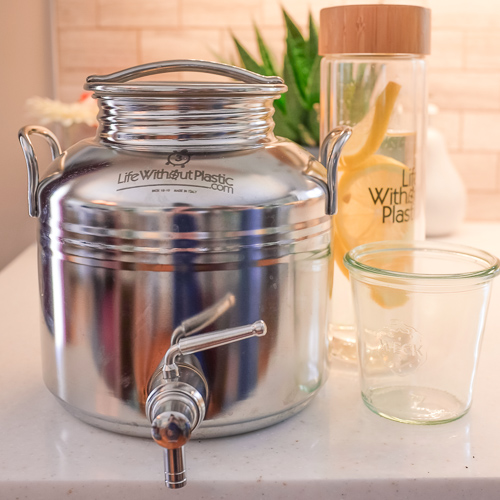
While there is more and more recognition of the toxicity of Bisphenol A (“BPA” found in polycarbonate plastic — even the FDA agrees with this) to human health and the environment, it is still extremely difficult to find a healthy alternative to the widely used 5 gallon large polycarbonate water bottle. We used to sell a glass 5 gallon bottle as a replacement, but it is extremely heavy when filled with water and difficult to transport. Then last year we discovered stainless steel water dispensers made in Italy. They are high quality, light weight, watertight and they can be used with or without a spigot. Perfect for transporting and dispensing water.  We used to carry theSuperfustinox but we have since changed to a different brand, Sansone, which is butt welded instead of being seam folded. 

These dispensers are made of really high quality food grade stainless steel 18-10 and they are beautiful.  We currently carry the cute 3 litre (0.8 gallon) for the fridge or to bring in the car on a road trip. The 5 litre (1.3 gallon) which is a perfect counter companion. The 10 litre (2.6 gallon) for camping and the 30 litre(7.9 gallon) for serious water transportation and dispensing. Last summer we brought our large water dispenser when going to the beach for the day. It was perfect. Easy to carry and the kids could just dispense their own water whenever they were thirsty.

Plastic Consumption On the Rise in India – Say Goodbye to the Tiffin Catering Services

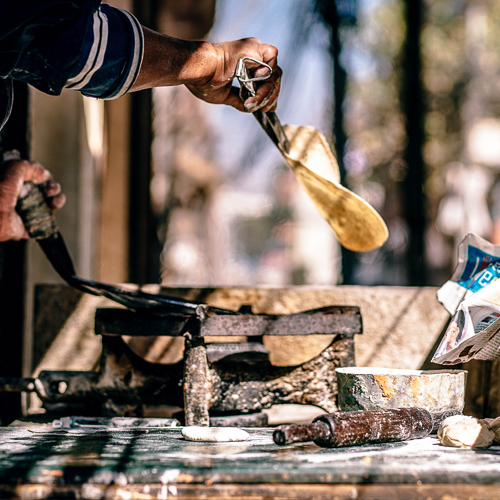
28 October 2009 — According to Karachi News Net, plastic goods consumption is expected to double in the next three years in India, most of it from food packaging. This news outlines a scary trend. When Jay and I visited India back in December 2002, I was impressed with how little plastic was used on a daily basis. Families could not afford to buy plastic products that would not last. Instead, they would use stainless steel containers that would be passed on from generations to generations. Most of the food was freshly prepared as refrigerators were not widely available. Tiffin food catering services were used for offering office workers fresh meals delivered to their office  doors. This is all changing as mentality is shifting from the long term to the short term. The disposable consumption mentality is making its way deep into middle class India.

Cheering for Fair Trade and Plastic Bag Free Town with a Hot Guy!

I already mentioned in an earlier post that Jay and I are involved in making our town – which is already officially designated as Fair Trade — a single use plastic bag free one. The Plastic Bag Free Town initiative will be launched on Saturday May 9th at the Fair Trade Fair in Wakefield, Quebec, and for the occasion a “fair trade” fashion show will be presented. Jay was recruited as one of the models. He is featured this week on our local newspaper The Low Down. You can see him this week only by clicking here

Is “Recyclable” the Greenwashing-est Word Around?

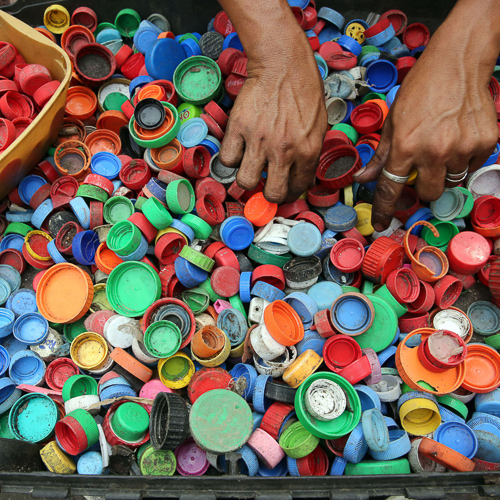
20 October 2009 — Rachel Cernansky, reporter at Planet Green recently wrote that “a brand that claims it is helping the environment by manufacturing recyclable products is not doing much more than greenwashing”  (seeRecyclable Is Not Recycled: Why Recyclable is the Greenwashing-est Word Around).  She gives plastic as an example of a product that is bad before, during and after its life cycle as a product. She is absolutely right. Only about 6.8% of all plastics are actually recycled. With such a small “success rate” you can safely say that in all practicality plastic is not really recyclable. Plastic is only marginally recyclable. In that context, taking pride of the fact that the plastic product you buy is green because it is recyclable is absolute greenwashing. I could not agree more.

Plastic — A Key Ingredient to Product Obsolescence

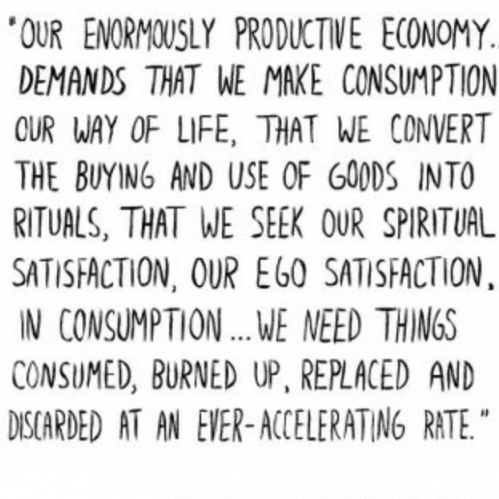
2 August 2009 — Have you seen The Story of Stuff? It is a powerful website with a very simple message about reducing our consumption. One part that struck me the most is when Annie Leonard talks about how obsolescence is purposely inserted into the design of products so that they break quickly and you have to buy a new one within a few years. Remember your grand-mother’s blender that would not break, or that heavy fridge that lasted forever? Soon corporations realized that it was not a good long term strategy to build products to last, they needed their customers to keep buying. There needed to be some weaker parts inserted into the design to make the product break after a set number of years, thereby re-starting the consumption wheel.  Plastic plays that role… 

The Disappearing Male — A Documentary to Watch

3 July 2009 — I recently discovered an extremely troubling documentary on the effects of endocrine disrupting chemicals, notably phtalates, Bisphenol A and brominated flame retardants (PBDEs) which are widely found in plastics, on the male population. These chemicals are said to affect males more  directly than females because they cause an hormonal imbalance in the mother’s womb at the time when male reproductive organs are being formed.

One sad example is the Aamjiwnaang First Nation community near Sarnia, Ontario, Canada where the proportion of male live births has been declining continuously since the early 1990s from an apparently stable sex ratio of 50%.

A Plastic Hummer or a Plant-Based Prius?

10 June 2009 — My 6-year old son is passionate about cars, trucks, tractors…essentially anything with motors and wheels.  The bigger the better.  He likes to taunt me by threatening that when he grows up he’s going to get a ‘plastic Hummer’.  Yikes, not what an ecologically minded parent running a plastic alternatives business loves to hear from his progeny.  But my son likes the Toyota Prius too, and is fascinated by the hybrid concept and the idea that one day soon we’ll be able to just plug in our car.  Now I can’t wait to tell him about the 2009 Prius, which incorporates various types of ‘ecological plastics’ throughout the car.  Toyota aims to have these materials eventually make up about 60% of the cars interior.  

Coca Cola Wants Your Attention with a Hybrid Plastic-Sugarcane Bottle

31 May 2009 —   Coca Cola wants to show it cares about the environment by introducing a new “eco-friendly” bottle for its Dasani water line. The new bottle which will be introduced later this year would be made from a blend of petroleum-based materials and up to 30% of plant-based materials. Initially these materials will include sugarcane and molasses, a by-product of sugar production. According to Coca Cola, the blend could make the recycling process easier and cheaper, and reduce the time that discarded bottles sit in landfills. Are you impressed? You shouldn’t be…

You’ve probably heard about the problem of plastic contamination in recycling plants. The problem is that some of the new plant-based plastics get recycled as if they were polyethylene terephthalate (PET).  But when they mix with the other petroleum-based plastics during the recycling process they end up creating a less stable recycled plastic that is of lower quality, hence lower value in the market.