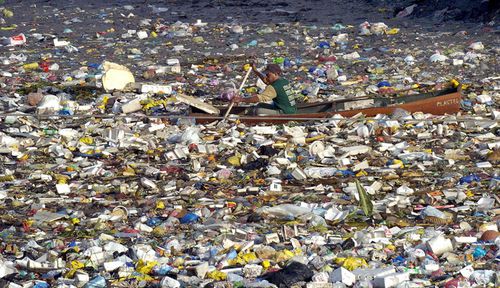
canoeing through plastic

Our Everyday Plastic Consumption is Like an Ongoing Giant BP Oil Leak

Think about it… all of the oil that is spewing out of BP’s open underwater well can be compared to all the plastic we throw out in the environment every single day…  Go to a take out restaurant and take a look at the garbage cans. The amount of disposable plastic in there multiplied by millions corresponds to the amount of plastic that is discarded every day in the world. It is estimated that there are at least 200 billion pounds of plastic in the ocean.  We look in horror at the gushing oil well, but we contribute to just as much pollution collectively every day by consuming and throwing out so much throw-away plastic.

An article by Daniella Russo, executive director of the Plastic Pollution Coalition entitled “The other, bigger ‘oil spill’: Your use of disposable plastic” made me reflect on the fact that we contribute every single day to the pollution of our environment through petroleum-derived objects we throw out.

21 June 2010 — Think about it… all of the oil that is spewing out of BP’s open underwater well can be compared to all the plastic we throw out in the environment every single day…  Go to a take out restaurant and take a look at the garbage cans. The amount of disposable plastic in there multiplied by millions corresponds to the amount of plastic that is discarded every day in the world. It is estimated that there are at least 200 billion pounds of plastic in the ocean.  We look in horror at the gushing oil well, but we contribute to just as much pollution collectively every day by consuming and throwing out so much throw-away plastic.

Photo credit: seacat.wordpress.com

(Photo: seacat.wordpress.com)

An article by Daniella Russo, executive director of the Plastic Pollution Coalition entitled “The other, bigger ‘oil spill’: Your use of disposable plastic” made me reflect on the fact that we contribute every single day to the pollution of our environment through petroleum-derived objects we throw out.

“We are simply using too much disposable plastic for the small percentage that gets recycled to even make a dent. And, unlike paper, glass, or stainless steel, most plastic can only be “down-cycled,” or used for increasingly fewer purposes. All the recycling, like using a teaspoon to empty the ocean, simply can’t stem the tide of plastic engulfing us.” (…)

“The most powerful thing people can do to clean up the oceans is to refuse to use “disposable” plastics in the first place. Let’s add “Refuse” to the list of R’s: Refuse-Reduce-Reuse-Recycle. Until we reduce our use of plastics wherever possible, real change will not happen. Recycling or cleanup projects alone won’t cut it.”

It takes a lot of will power to plug that gushing well of disposable plastic production. Just as every small plastic-use gesture contributes to creating it, every small gesture can also help plug it.

Chantal Plamondon, Co-Owner
LifeWithoutPlastic.com
website preview

The Plastic Industry is Rejoicing Over Its Conquest of our Daily Lives

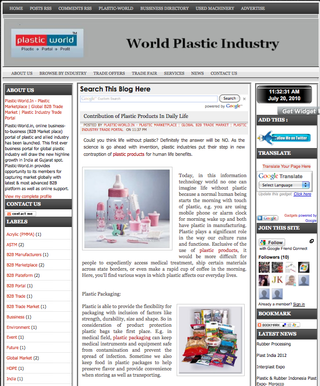
Check out this post on a website called “World Plastic Industry”. It describes how plastic has become indispensable in our daily lives… starting with your mobile phone and alarm clock, it goes through everything we use on a daily basis including packaging and building materials. It makes me feel so sad to realize that we have been won over with subtle but durable changes to our lifestyles that now seem irreversible.  Irreversible because in some cases, we have completely lost the incentives to create non-plastic alternatives because the whole infrastructure has changed to accommodate plastic-based solutions. One good example comes from the packaging industry.  Plastic is now being recognized as the only “hygienic” way of packaging take-out food. When I approached a local restaurant in my town to offer some reusable stainless steel containers for take out food, they decided to pass because they could not be certain people will clean their containers properly, and they do not want to take responsibility for bacteria that could eventually contaminate the food.

youtube video preview

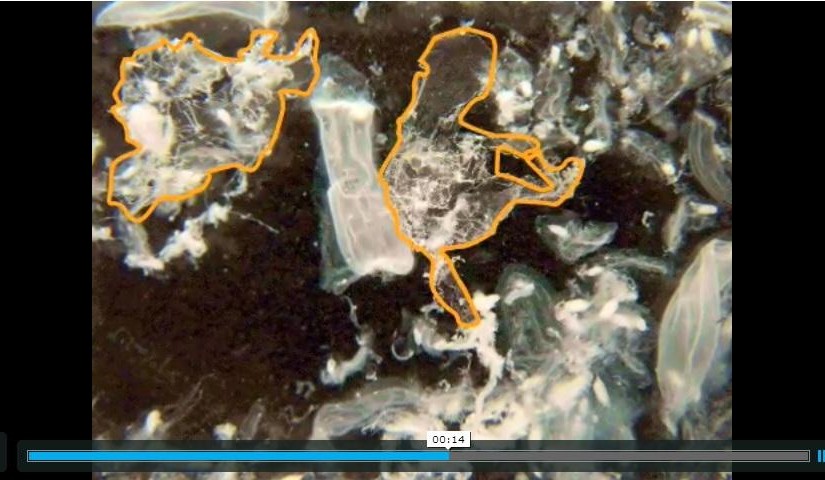
Video: Plastic Mistaken for Zooplanktons

This is a very short video showing how easily plastic bits can be mistaken for zooplankton by marine mammals and fish. It is quite astounding. This video was put together by 5gyres.org and the water sample was taken from the North Atlantic plastic gyre… Did you know five of those plastic gyres have now been discovered. Yikes! 


Stainless Steel in Toaster Oven Prevents Aluminum Garnish on Burrito

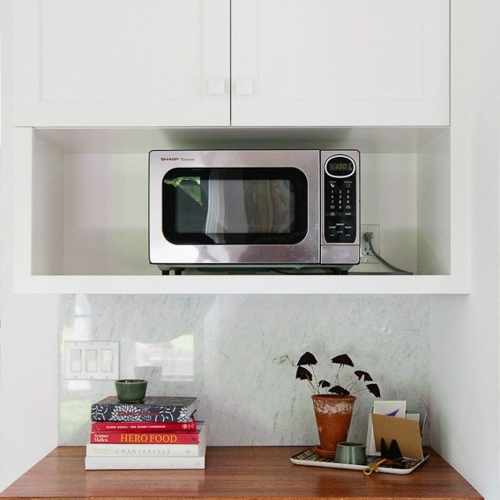
2 December 2009 — Yesterday, I was looking for something to eat and found in our freezer a frozen Amy’s Burrito (unfortunately wrapped in plastic). I checked the instructions: either re-heat in a microwave or wrap in aluminum foil and re-heat in oven. Heating it up in a microwave oven was not an option. We haven’t had a microwave oven for more than 10 years.  Ever since my mother passed away of stomach cancer in 1992, I always wondered if the old microwave oven we used to have in the middle of our kitchen caused her cancer. I am convinced it was “leaking” radiation. It was one of the first models available on the market in the ’70s. I have also always wondered how the radiation affects the composition of the food, let alone of the container used to heat it up.

Heating it up in aluminum can be perilous. In contact with acidic food, aluminum tends to “melt” or disintegrate which is why you often see little holes on the aluminum foil covering a lasagna. Scary! So this was not an option either.

Replacing Your Polycarbonate 5 Gal Bottle with A Snazzy Italian Stainless Steel Water Dispenser

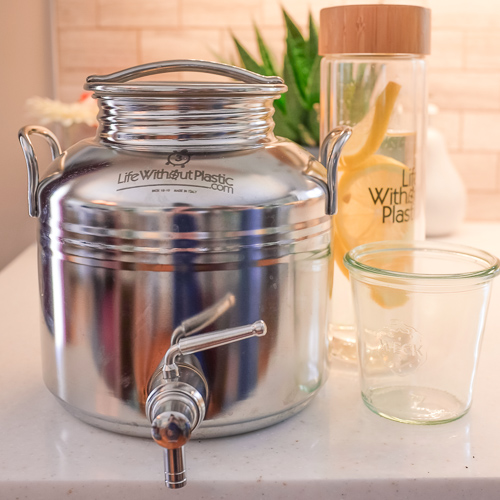
While there is more and more recognition of the toxicity of Bisphenol A (“BPA” found in polycarbonate plastic — even the FDA agrees with this) to human health and the environment, it is still extremely difficult to find a healthy alternative to the widely used 5 gallon large polycarbonate water bottle. We used to sell a glass 5 gallon bottle as a replacement, but it is extremely heavy when filled with water and difficult to transport. Then last year we discovered stainless steel water dispensers made in Italy. They are high quality, light weight, watertight and they can be used with or without a spigot. Perfect for transporting and dispensing water.  We used to carry theSuperfustinox but we have since changed to a different brand, Sansone, which is butt welded instead of being seam folded. 

These dispensers are made of really high quality food grade stainless steel 18-10 and they are beautiful.  We currently carry the cute 3 litre (0.8 gallon) for the fridge or to bring in the car on a road trip. The 5 litre (1.3 gallon) which is a perfect counter companion. The 10 litre (2.6 gallon) for camping and the 30 litre(7.9 gallon) for serious water transportation and dispensing. Last summer we brought our large water dispenser when going to the beach for the day. It was perfect. Easy to carry and the kids could just dispense their own water whenever they were thirsty.

Plastic Consumption On the Rise in India – Say Goodbye to the Tiffin Catering Services

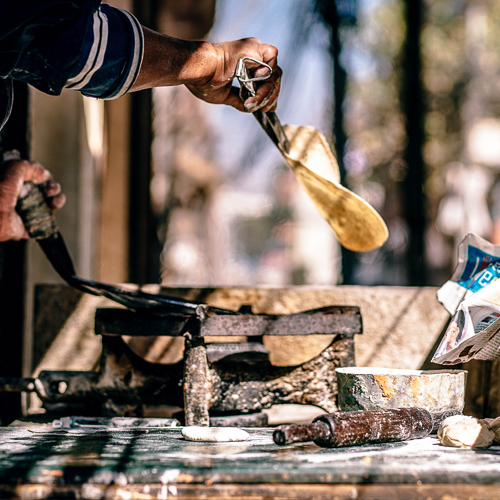
28 October 2009 — According to Karachi News Net, plastic goods consumption is expected to double in the next three years in India, most of it from food packaging. This news outlines a scary trend. When Jay and I visited India back in December 2002, I was impressed with how little plastic was used on a daily basis. Families could not afford to buy plastic products that would not last. Instead, they would use stainless steel containers that would be passed on from generations to generations. Most of the food was freshly prepared as refrigerators were not widely available. Tiffin food catering services were used for offering office workers fresh meals delivered to their office  doors. This is all changing as mentality is shifting from the long term to the short term. The disposable consumption mentality is making its way deep into middle class India.

Cheering for Fair Trade and Plastic Bag Free Town with a Hot Guy!

I already mentioned in an earlier post that Jay and I are involved in making our town – which is already officially designated as Fair Trade — a single use plastic bag free one. The Plastic Bag Free Town initiative will be launched on Saturday May 9th at the Fair Trade Fair in Wakefield, Quebec, and for the occasion a “fair trade” fashion show will be presented. Jay was recruited as one of the models. He is featured this week on our local newspaper The Low Down. You can see him this week only by clicking here

Is “Recyclable” the Greenwashing-est Word Around?

20 October 2009 — Rachel Cernansky, reporter at Planet Green recently wrote that “a brand that claims it is helping the environment by manufacturing recyclable products is not doing much more than greenwashing”  (seeRecyclable Is Not Recycled: Why Recyclable is the Greenwashing-est Word Around).  She gives plastic as an example of a product that is bad before, during and after its life cycle as a product. She is absolutely right. Only about 6.8% of all plastics are actually recycled. With such a small “success rate” you can safely say that in all practicality plastic is not really recyclable. Plastic is only marginally recyclable. In that context, taking pride of the fact that the plastic product you buy is green because it is recyclable is absolute greenwashing. I could not agree more.

Plastic — A Key Ingredient to Product Obsolescence

2 August 2009 — Have you seen The Story of Stuff? It is a powerful website with a very simple message about reducing our consumption. One part that struck me the most is when Annie Leonard talks about how obsolescence is purposely inserted into the design of products so that they break quickly and you have to buy a new one within a few years. Remember your grand-mother’s blender that would not break, or that heavy fridge that lasted forever? Soon corporations realized that it was not a good long term strategy to build products to last, they needed their customers to keep buying. There needed to be some weaker parts inserted into the design to make the product break after a set number of years, thereby re-starting the consumption wheel.  Plastic plays that role… 

The Disappearing Male — A Documentary to Watch

3 July 2009 — I recently discovered an extremely troubling documentary on the effects of endocrine disrupting chemicals, notably phtalates, Bisphenol A and brominated flame retardants (PBDEs) which are widely found in plastics, on the male population. These chemicals are said to affect males more  directly than females because they cause an hormonal imbalance in the mother’s womb at the time when male reproductive organs are being formed.

One sad example is the Aamjiwnaang First Nation community near Sarnia, Ontario, Canada where the proportion of male live births has been declining continuously since the early 1990s from an apparently stable sex ratio of 50%.