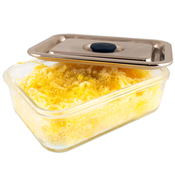
26 January 2011 — I have already discussed my reservations about microwave ovens and their links with cancer (see myolder post: Stainless Steel in Toaster Oven Prevents Aluminum Garnish on Burrito). However, many people find them extremely useful and they are a common feature at schools and office cafeterias. Fortunately, we have discovered a fantastic new line of products which allow you to re-heat your food in a microwave without worrying about plastic touching your food. These are borosilicate glass food containers that are heat and cold resistant. They can be used to warm up food in the oven, toaster oven, microwave oven and they can also store food in the freezer. They come with an 18-8 food grade stainless steel lid featuring an ingenious silicone seal system that allows you to create an airtight seal by pressing a button. To release the seal, the button just needs to be pulled up.
The Perfect Tray for Last Minute Breakfast in the Car
If you are like me, you probably rush to the last minute in the morning in order to get your child’s lunch ready on time while making sure he gets dressed, eats his breakfast and brushes his teeth. Unfortunately, sometimes I am just not efficient enough to get all these tasks done on time, so we have to leave quickly and bring our son’s breakfast in the car. We just found these really practical little food trays, just perfect for breakfast in the car. Mind you, they are also great for the picky kid who doesn’t like it when various parts of his meal mingle together. The tray is made in Korea of high quality stainless steel 18/8. It is of course BPA-free, phthalate-free, lead-free and it is dishwasher-safe.
Plastics and Breast Cancer
11 September 2010 — Plastics can cause or contribute to breast cancer. Our dear friend Janet has breast cancer and we can’t help but wonder if some plastic chemicals have played a role in the development of her disease. When she was first diagnosed, she had stage 3 breast cancer in 2005 and was still breastfeeding her 6 month old son. Stage 3 means that although her cancer had not spread to other organs, some cancerous cells had been found in her lymph nodes. She immediately had her right breast surgically removed and started chemotherapy. Two years later, her cancer progressed to stage 4 when metastases were found in her lungs. After treatment her cancer went into short remission and then last summer, a tumour was found in her brain. As she puts it, she “tripled” her prognosis and one year later leads a very full and active life. She continues to be very involved on the advocacy front, trying to help traditional medicine embrace a more holistic approach toward cancer.
Plastic Residue from Blood Bags End Up in Blood Stream
10 October 2010 — A friend of ours who is a major cycling fan sent us this news story about Alberto Contador, the Spanish cyclist who won the Tour de France this summer (and last year). Apparently he is suspected of having used the performance-enhancing drug called clenbuterol through intravenous supply. He says that it is through food cross-contamination that traces of the drug ended up in his bloodstream. However, along with traces of the drug, officials also found “traces of a plastic residue the same as the type used to manufacture blood bags”. So he is probably lying…
If it Does not Say where it is Made, it is Probably Made in China
28 January 2010 — I don’t know about you, but I like to have as much information as possible about a product before I buy it so I can make an informed decision. One information that I find difficult to find on many shopping websites is the country of origin. This is an important information but on many websites, you can assume that if the place of origin of a product is not indicated, then it probably comes from China.
I generally prefer not to buy from China unless the product is absolutely unique, high quality and not available from a different country. My main reason for avoiding Chinese products is my deep empathy for what Tibetan people and other minorities are enduring in this country. Chinese dissidents who dare to criticize the government are arrested and jailed. I also have strong reservations about this country’s environmental policies. I must admit also that the 2007 melamine scandal still pops to my mind when I think of products made in China.
Canada to Introduce Plastic Money (Plastic Bills)
10 March 2010 — In its latest budget just introduced a few days ago, the Canadian Government announced it will introduce plastic dollar bills starting next year. These dollar bills will be replacing the current cotton-based money.
According to the Canadian Government, this is a “green” step because the new plastic bills are reportedly ore durable as they last 4 times longer than the current biodegradable money. This will represent savings for the Canadian Governments as this new money is cheaper and harder to counterfeit.
The Best Non-Plastic Mattresses
31 March 2010 — While the mattresses that my grand-mother used to sleep on were made out of cotton, wool or straw (she was born in 1907), nowadays they are mostly made of foam. Petroleum-based polyurethane foam used in mattresses breaks down over time and, according to a study by the Consumer Product Safety Commission reported in the Washington Post in April 2008, releases 0.802 mg of antimony and 0.081 mg of boric acid (the poison used to kill cockroaches) in the air every night. These amounts are apparently OK if you are more than 5 years old (!). And formaldehyde – declared toxic under the Canadian Environmental Protection Act – can be present in box spring glue. Conventional mattresses for children may also contain phthalates, and often flame retardants such as poloybrominated diphenyl ethers (PBDEs are banned in Europe and are being phased out in the United States… but are still very legal in Canada).
My friend Jean Corriveau is a pioneer in the world of non-plastic healthy mattresses and he manages his business in a very honest and ethical way. He is just the nicest person, full of integrity, who would never compromise on quality. He is the owner of Sleeptek which developed a completely natural mattress line 15 years ago in response to demands from some of his highly chemical-sensitive clients. His Obasan mattresses are not only made of organically grown cotton and sustainably harvested natural rubber, but the wool he uses comes from a family-run organic sheep farm in the Netherlands. The wood in the box springs comes from Quebec spruce — sustainably harvested — and no synthetic glues, dyes or finishes are used. (Read more:http://www.nationalpost.com/life/footprint/story.html?id=2072160#ixzz0jif8xE9h)
Canned Food You Can Trust – A list of BPA-Free Lining Canned Products
We continually hear about how bad bisphenol A (BPA) is for everybody and particularly for infants and pregnant women. The evidence is there. For those still skeptical, the precautionary principle dictates that you should be cautious. It is mind boggling that the food industry is so slow to remove BPA from the lining of food cans. Fortunately, some food companies understand the problem and have switched to non-BPA linings for their cans. They do not necessarily advertise this fact on their cans, so you need to memorize this list! Here they are:
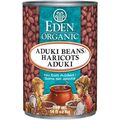
1) Eden Food: They have been using BPA-free linings in their cans for more than 10 years! How visionary! Although the cans cost 14% more, the company feels it is worth it. I think so too. While Jay and I generally avoid buying canned food because of BPA, we are happy to indulge in a good vegetarian chili with non-BPA canned beans once in a while. Unfortunately, Eden’s tomatoes are still offered in BPA-lined cans because of the acidic nature of tomatoes… So try and find a brand of tomatoes packaged in a glass jar. This is especially important because acidic food increases the deterioration of the BPA lining and thus increases its leaching.
Become an Environmental Leader: Switch Wine Bottles from Glass to Plastic?
13 May 2010 — The website EnvironmentalLeader.com recently praised Marks & Spencer for switching all of its mini wine bottles from glass to “environmentally-friendly” polyethylene terephthalate (PET) plastic in the UK market. Since when has PET plastic become more environmentally-friendly than glass? From an energy consumption point of view, plastic production uses marginally less energy than glass (2,013 BTUs for PET versus 2,155 BTUs for glass) and perhaps this is where plastic may appear more environmentally-friendly. But if you look at the total life cycle of one single bottle, plastic and glass, you realize that glass is significantly superior:
- Glass containers can be cleaned and reused several times as part of consignment programs. We use milk from the company Harmony Organic (TM) which comes in a glass bottles that the company collects back, cleans and refills. PET bottles should not be reused as they deteriorate very quickly and can present increased health risks.
- Glass is highly recyclable, in fact it can be recycled eternally, because its structure does not deteriorate when reprocessed. Plastic bottles can only be recycled once. They can then simply be downcycled into an item that would not be used for food or drink such as fabric fibres for bags or clothes.